
Every week I’m asked by parents about sugar for babies and children and whether they should be worried about the sugar in their little one’s diet. Is fruit OK? Are pouches too sugary? Is homemade better than shop-bought? I totally understand why it feels confusing, especially with so many headlines about sugar.
In this blog I want to focus specifically on babies and young children. I’ll cover how much sugar is recommended at each age, the difference between added, free and naturally occurring sugars, what the 2026 SACN guidance means for purées and pouches, and how to make sense of food labels. My aim isn’t to demonise sugar or make anyone feel guilty. It’s to share the evidence in a way that’s simple and realistic for family life.
Firstly, why all the fuss about sugar?
Sugar alone offers little to no nutritional value, beyond calories. It is therefore not a food that is a ‘necessary’ part of our diets. Babies and young children in particular don’t need sugar. Consuming a lot of foods that are high in added sugars, such as cakes, pastries and biscuits can mean that they become full quickly. Without having had enough vitamins and minerals from a variety of foods.
You might also hear stories saying that sugar is “addictive” or “toxic”. As well as that it causes multiple types of cancer. It’s important to note that there’s no evidence to support these types of claims. So, whilst it’s true that sugar is not necessarily ideal to be offering to young babies or children, scaremongering headlines such as these are not helpful. Nor are they truthful.
How much sugar can my baby or child have?
Recommendations from the UK government are that ‘free sugars’ – those that are added to food and drinks or sugars found naturally in honey, syrups and unsweetened fruit and vegetable juices, smoothies and purees – should not make up more than 5% of our total daily energy / calorie intake. This recommendation applies from 1 year of age.
- For 11+ years, this means that the recommended maximum sugar intake is 30g/day (equivalent to 7 sugar cubes).
- For 7-10 years this means 24g/day (or 6 sugar cubes).
- For 4-6 years, no more than 19g/day (or 5 sugar cubes).
- For 2-3 years, no more than 14g/day (or 3.5 sugar cubes).
- For 1 year, no more than 10g/day (or 2.5 sugar cubes).
For babies under 1 year, there are no guidelines limits around sugar. Sugar and sugary foods are not recommended to be added to babies’ foods and it’s best to keep added sugar in babies’ diets to a minimum.
What is the effect of sugar on young children’s behaviour?
Although there is a common notion that too much sugar can negatively affect children’s behaviour, existing scientific studies have not found a link between the two. What isn’t in doubt is that sugary foods are highly palatable, so it’s easy for children to eat more of them than they need. Free sugar causes tooth decay, provides little nutrition and therefore isn’t necessary in the diet because children can get all the nutrients and energy they need from alternative nutrient-dense food.
What about sweeteners like stevia?
EU regulations state that sweeteners should not be used in foods prepared for infants and young children. This is mainly due to lack of data on the safety or sweeteners for infants and young children, as well as the fact that children need high-energy and nutrient-rich foods. Don’t worry if you’ve already given your little one foods containing artificial sweeteners – a little is never going to be a problem – it’s just best to try to avoid them in your little one’s diet where possible.


‘Added’ vs ‘natural’ sugars
One of the most confusing things about understanding sugar intake is the difference between what counts as ‘natural’ sugars and what counts as an ‘added’ or ‘free’ sugar (free/added being the type we ideally want to limit). This is made even more confusing by the MANY sugar alternatives marketed as ‘healthier options’. When they’re simply just added sugars in a different name. Any variation of sugar or syrup, whether it’s coconut sugar, date sugar, rice sugar or maple syrup or agave nectar (along with many more examples). All of these count as added sugar as our bodies will still process it the same way.
You may read that the natural alternatives to sugar, including maple syrup and coconut sugar, have benefits of micronutrients that regular sugar does not. However, the quantities in which your little one would need to eat those in order to get any benefit, are far too high and would go well beyond recommended sugar intakes. There are much easier and more beneficial ways for babies and children to get their micronutrients!
The table below breaks down what is included in the definition of free vs. natural sugars

Adapted from: nutrition.org
What the latest SACN report says about free sugars
In 2026, the Scientific Advisory Committee on Nutrition (SACN), the expert group that advises the UK government on nutrition, published a statement clarifying how free sugars apply to fruit and vegetables that have been processed in different ways. I’m asked about this ALL the time, so I wanted to add it here.
Free sugars are made up of two things:
- Added sugars: any sugar added to food or drinks by a manufacturer, a cook or you at home. This includes table sugar, honey, syrups and all the “alternative” sugars I mentioned above.
- Sugars released from fruit and vegetables: when fruit and veg are broken down so their structure is no longer intact, the sugars inside are released. These count as free sugars too. This includes juices, smoothies, purées, pastes and powders.
The focus is on the structure of the food. All the sugar in fruit and veg is naturally occurring, so whether a sugar is “natural” isn’t really what matters. It’s whether the sugar is still locked inside the cells of the food, or whether processing has released it.
Sugars still locked in (not counted as free sugars):
- Whole fruit and veg
- Chopped, sliced, diced or grated fruit and veg
- Dried fruit where the fruit stays intact, such as raisins and dried apricots
- Stewed fruit that keeps its shape
- Tinned or frozen fruit in pieces
Sugars released (counted as free sugars):
- Juiced, blended, puréed or liquidised fruit and veg
- Mashed, sieved, crushed or pressed fruit and veg
- Stewed fruit that has been cooked down until it falls apart
- Tinned or frozen fruit that has been puréed
- Fruit and veg powders, plus freeze-dried and fully dehydrated products
So what’s actually changed?
This is a clarification of the definition of free sugars, rather than a ‘substantive change,’ according to SACN. The previous definition didn’t mention things like mashing, sieving, chopping or grating, which left lots of parents (and food companies!) unsure. Now mashing, sieving, crushing and pressing are clearly included in the definition of a free sugar, and chopping, slicing, dicing and grating are clearly excluded. Vegetable purées are counted in exactly the same way as fruit purées, although SACN notes that vegetables are naturally lower in sugars.
Importantly, the overall advice regarding sugar intake hasn’t changed. Free sugars should still make up no more than 5% of daily energy, and we should still aim for at least 5 portions of a variety of fruit and veg each day.
It’s also worth knowing that the UK takes a slightly stricter view than the World Health Organization (WHO). The WHO definition only mentions sugars naturally present in honey, syrups and fruit juices, and doesn’t mention purées or smoothies at all. So if you’ve seen different advice elsewhere, that’s probably why.
Can my baby or toddler have fruit juice or smoothies?
It can often confuse parents that whole fruits are OK to offer to children but juices and smoothies count as free sugars (the same group that added sugars sit in). This is because sugars that are found in whole fruits are maintained within the cell structure and are therefore released more slowly when eaten. Th
e sugars found in juices and smoothies, on the other hand, have been released from inside the cell during the processing. They are therefore consumed more easily and quickly, meaning we can have too many a lot more easily than with whole fruits. Additionally, whole fruits contain all of the beneficial fibre, which can be lost or reduced in juice and smoothies.
I’ve written before about what drinks to offer babies and toddlers, with The Mummy Dentist. I’ll share the tips specific to juices and smoothies again here:
- NHS guidance states “babies under 12 months don’t need fruit juice or smoothies”
- If you do choose to give juice or smoothies to your toddler over age 1 ensure it is diluted (one part juice: 10 parts water) and from an open cup.
- From age 5 children can have fruit juice undiluted but stick to no more than 1 portion in a day. Even as an adult a 150ml glass can only count as ONE of your 5-a-day.
- Keep fruit juice and smoothies to mealtimes only (rather than in between) to reduce the frequency of acid attacks.
- You could make smoothies containing veggies, oats and yogurt and serve these as a ‘smoothie bowl’ with a spoon too.
What about purées, mashed fruit and pouches?
This is a key question I get all the time, and arguably the most relevant for parents and carers.
Is homemade better than shop-bought?
When it comes to free sugars, both count according to the definition. If fruit or veg has been blended or mashed, the sugars are counted as free sugars whether it was made in a factory or in your kitchen. SACN applies the same definition to both. HOWEVER, there is some nuance. SACN noted that industrial processing is likely to break food down more than home cooking, so shop-bought purées are likely to be a little higher in free sugars.
For me, the biggest benefit of homemade isn’t really the sugar. It’s being able to change the texture as your baby grows, from smooth to mashed to lumpy, alongside appropriate finger foods. That’s SO important for developing eating skills, and it means more of what your little one eats stays whole. Shop-bought purées and pouches are absolutely fine too, though. Use whatever works for your family.
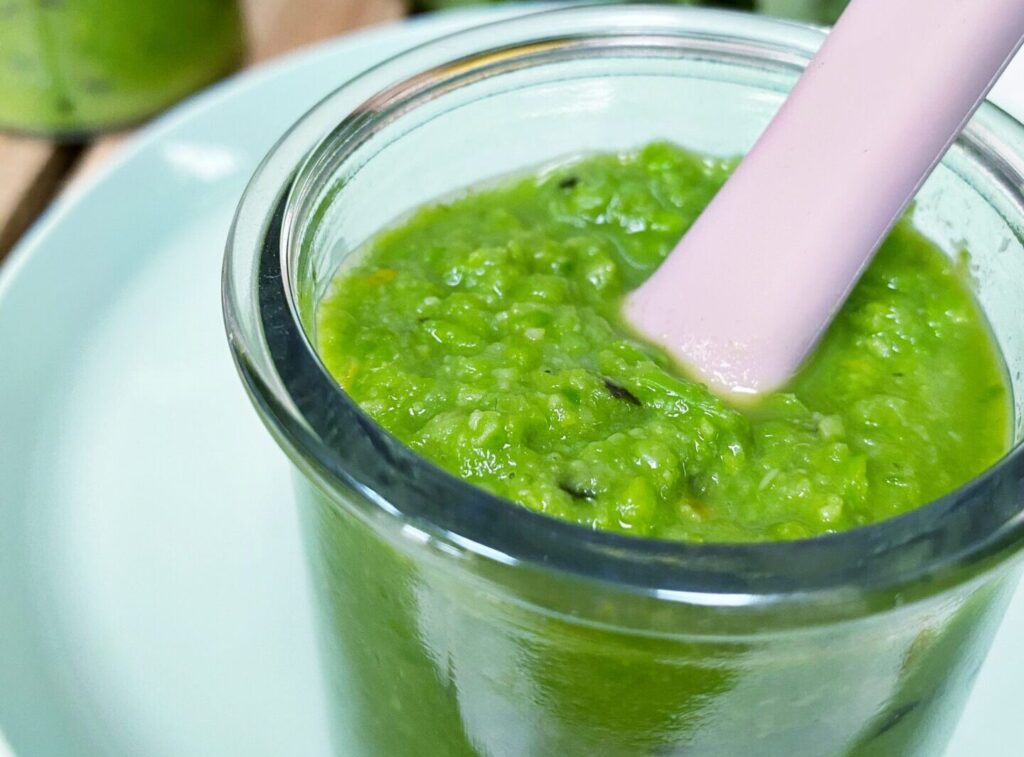
Does mashed banana count the same as a biscuit?
Technically, both contain free sugars. But counting mashed and puréed fruit as free sugars is mostly to be able to define and group foods, rather than assessing their impact on health. Breaking food down releases some of its sugar, and so the UK definition counts ALL the sugar as free once the structure is broken. SACN does note that the effect of processing will not be the same across all types of processing, but it is keeping all types of processing within the definition.
What we don’t know, and what the definition ISN’T commenting on:
- How much sugar is actually released by different types of processing. There isn’t yet a reliable way to measure it.
- What difference it makes to children’s health. The few studies we have are small, short-term and mostly in adults, and they don’t all agree. We don’t have long-term research looking at purées or mashed fruit and things like tooth decay.
My top tips for purées and pouches:
- Check the ingredients, not the name on the front. Ingredients are listed in order of weight, so a “spinach and pea” pouch can be mostly apple. Veg-led options are a great choice.
- Squeeze pouches into a bowl or onto a spoon rather than letting your little one suck from the spout. This helps them see, smell and explore their food, and it’s better for teeth.
- Keep moving through textures towards mashed, lumpy and finger foods.
- Offer purées, smoothies and fruit snacks at mealtimes rather than to graze on throughout the day.
- Note that snacks like melts, puffs, fruit leathers and freeze-dried fruit are all made from broken-down fruit, so they count as free sugars even when they say “no added sugar”.
You can read more about my advice for using food pouches when feeding your baby, here.
Understanding sugar on food labels
My blog on reading labels specifically for toddlers, covers this. However, below is a bit more information specific to sugar on nutrition labels.
It’s worth knowing that free sugars aren’t shown on nutrition labels at all. The “of which sugars” figure is the total sugar in the product. That includes the sugars naturally found in milk and whole fruit as well as any free sugars, so the ingredients list is the best indication.
Unfortunately, nutrition information in the UK currently doesn’t differentiate between free and added sugars on labels. Which can make it hard to understand how much added sugar is in foods. The nutrition labels you see will have the following information:

The ‘of which sugars’ refers to both added and free sugars. So a plain yoghurt may have 8g of sugar, but as this comes from the sugars naturally present in milk, this wouldn’t count to your child’s daily added sugar intake. The best way to check how much added sugar is in the food and drinks you buy is to check the ingredients list. A plain yoghurt with no added sugar will have only ‘yoghurt’ in the ingredients. Whereas a flavoured yoghurt may include “fruit purée”, which counts as free sugars.
Summary and take-home points
- Free sugars include added sugars (such as sugar, honey, syrups and fruit juice concentrate) plus the sugars released when fruit and veg are juiced, blended, puréed or mashed.
- Sugars still locked inside whole, chopped or grated fruit and veg, tinned or frozen fruit pieces and intact dried fruit like raisins, plus the sugars naturally found in milk, plain dairy and cereal grains, don’t count as free sugars.
- Juice and smoothie sugars count as free sugars. Offer whole fruit where possible, or diluted juice at mealtimes.
- Purées count as free sugars whether homemade or shop-bought, but they can still be part of your baby’s diet. Keep moving through textures and focus on cutting down added sugars.
- Nutrition labels show total sugars in the “of which sugars” number. Free sugars aren’t listed, so check the ingredients list.
And finally, do check out my blog of low-sugar recipes that are perfect for babies and toddlers. You may also like to read my post, ‘Can My Baby Have Chocolate?’ as well as the blogs I wrote on the 5 ways to flavour family food without salt and sugar and why your child’s nursery may offer puddings.
Frequently asked questions about sugar for babies and children
Can babies have sugar?
Babies under 12 months shouldn’t have added sugar or honey. There’s no set limit for free sugars at this age, but UK advice is to keep sugary foods to a minimum. The sugars naturally found in breast milk, formula and whole fruit and veg are not a concern.
What are free sugars?
Free sugars are sugars added to food and drinks (such as table sugar, honey and syrups) plus the sugars released when fruit and veg are juiced, blended, puréed or mashed. Sugars still locked inside whole or chopped fruit and veg, and the sugars naturally found in milk, are not free sugars.
Are pouches high in sugar?
Fruit-based pouches can be high in sugar. Even with “no added sugar” on the front, the sugars in puréed fruit count as free sugars. Choosing veg-led pouches, squeezing them onto a spoon or into a bowl and offering them at mealtimes can all help. Whilst fruit and vegetable purees both technically count as free sugars, vegetables are naturally lower in sugars.
Is homemade purée better than shop-bought?
Both count as free sugars, because blending or mashing releases the sugars whether it’s done in a factory or at home. Shop-bought purées are likely to be slightly higher. The biggest benefit of homemade is being able to change the texture as your baby grows.
Does mashed banana count as free sugar?
Yes, under the UK definition mashed fruit counts as free sugars, because mashing breaks down the fruit’s structure. However, this is an approach for classifying foods, not evidence that mashed banana is harmful. It doesn’t mean you can’t or shouldn’t offer your baby mashed fruit.
