
When you’re navigating the supermarket aisles, choosing the right foods for your toddler can feel like a total minefield.
I often get asked by parents: “What should I actually be looking for on food labels?” If you fre
quently rely on pre-packaged snacks or meals for your little ones, this guide is for you. Knowing how to decipher those numbers can make choosing healthy options so much simpler.Using Food Labels to Choose Healthier Options
In an ideal world, we might all be cooking everything from scratch. However, this just isn’t possible in the modern-day world of parenting and relying on pre-made children’s food is absolutely fine for convenience and for when you’re out and about. If you’re looking for more tips on eating out with a baby or toddler, I’ve got a blog with plenty of advice. I know many parents have questions about processed foods for children as well, so do check out my tips.
Many parents are confused about some of the toddler foods on the shelves, and there are often lots of questions raised about how ‘healthy’ some of the foods available to our children are. Parents often want to know a couple of basics:
- Are the products healthy options?
- How often should I be offering them to my kids?
It can be hard to decipher this, so I’ve put together a guide to break down what you need t
o look for when reading labels. The two infographics below are a really quick step-by-step on what to look for on labels. I’ve added a bit more context below and in another blog we’ll go into more detail on some of the other aspects to be aware of on food labels and packaging.

A few extra tips on label reading
1.) Check the 100g column
- The “per 100g” column gives you the percentage of a nutrient that is in your product. For example, if the 100g column say 80g of sugar – the product is 80% sugar.
- Check for salt & fibre content too:
- You can read more on salt in my blog here, but recommended total daily salt intakes are:
- <1g for babies 6-12 months
- <2g for toddlers 1-3 years
- <3g for children 4-6 years
- You can read more on salt in my blog here, but recommended total daily salt intakes are:
- For fibre, there’s no recommended intake for under 2’s, but for 2-5-year olds, aim for 15g per day. Read more about fibre recommendations for young children, here.
This graphic from Charlotte Radcliffe from The Nutrition Consultant shows a quick guide to sugar and fibre content on labels!
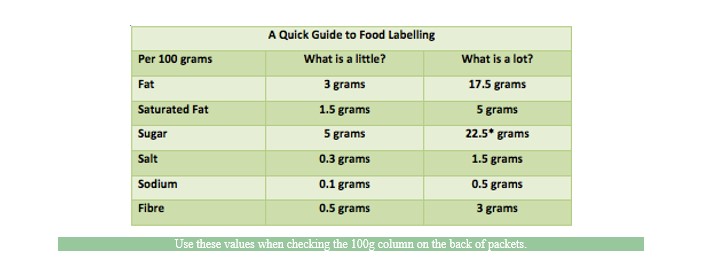
2.) Check portion sizes
- As well as the 100g column, there will also be a recommended portion size – e.g. in the visual above “per bar” or it might say “per 30g portion” for example. the portion sizes are set by the manufacturers themselves, and this is not always realistic to what is consumed.
- Try to visualize if this portion size is reflective of what your little one would actually eat. Is it a realistic portion size? If not, how much sugar or salt would be in an average portion for your little one?
3.) Check the salt and sugar your little one is likely to eat in a portion and compare with recommendations above.
4.) Check the ingredients list
- Check the ingredients list on the back of the packet to see if it reflects what you would expect to be in the dish/product. The ingredients will be listed in order of how much of each ingredient is in the product – with the highest first. So, for example if you’re looking at a beef spaghetti bolognese, you’d expect the first ingredients to be something similar to: spaghetti, beef and tomatoes!
- Check that the name of the product is reflective of what is in the ingredients list too. For example:
- Avoid choosing a spaghetti bolognese which is 60% apple…!
- Products with “vegetable” in the name may use vegetable powder, which may contribute very little to the nutrition.
- Look out for sugar and salt added in the ingredients list and try to limit options where a lot is present. Sometimes these are easy to spot but, some say ‘no added sugar’, even if they have been sweetened with ‘fruit juice concentrate’ or ‘fruit purees’ – which Public Health England still counts as “added sugars”. These fruit sugars still count as ‘free sugars’ as when processed these fruit sugars are absorbed in the same way as other simple sugars.
- Try and focus on foods that include ingredients you would use at home e.g. wholegrains, oats, oil, whole fruits, whole veggies, rice, meat, beans etc
If you want to read more about how much salt babies should have, or sugar recommendations for young children, check out my detailed blogs.
And those are my top tips for reading food labels! Hopefully these will help you in navigating food labels and understanding what’s in some of the products you pick up. In part two of Making Sense of Food Labels for your Toddler, we look in a bit more detail on some other aspects of food labels, including allergies, added sugars, health claims and traffic light labels.