
In part one of my guide to food labels, we looked at the basics of the “per 100g” rule and the ingredients list. However, food packaging is covered in other information, from health claims to organic symbols, that can be just as confusing.
In this blog, we’ll cover some of the other important aspects to help you understand w
hat to look out for on food labels when choosing foods for your family.Why is it important to understand food labelling?
A 2019 government report found that many products available that are marketed to infants and toddlers are not in-line with dietary guidelines for this age group. For example, it was suggested that a number of the snacks and finger foods available are nutritionally similar to confectionary, rather than the nutrient-dense snacks which are needed and recommended for growing kids.
Interestingly the report also found that many parents feel misled when it comes to the baby and toddler foods available to them on the shelves.
The aim of this blog is to help to exp
lain the various information you can find on food labels.Using Food Labels to Check for Allergies:
If your child has a food allergy or intolerance, reading the back of the packet isn’t just helpful, it’s essential. In the UK and EU, there are strict laws (often referred to as “Natasha’s Law”) regarding how allergens must be declared on pre-packaged foods.
By law, food businesses must declare the presence of the 14 most common allergens if they are used as ingredients in a product. These include:
- Cereals containing gluten (wheat, rye, barley, oats)
- Milk, Eggs, and Fish
- Peanuts and Tree Nuts (like almonds, hazelnuts, walnuts, cashews)
- Soya, Sesame, and Mustard
- Celery, Lupin, Molluscs, and Crustaceans
- Sulphites (often found in dried fruits)
Allergens must be emphasised within the main ingredients list itself. Manufacturers usually do this by using bold, italics, or CAPITAL LETTERS.
Example: If a biscuit contains milk, the ingredients list will look like this: Ingredients: Wheat flour (Wheat), Sugar, Vegetable Oil, Whole Milk Powder, Salt.
For more information on reading food labels for food allergies, check out my blog on coping with food allergies.
Portion control
Food labels will usually provide the nutrition information ‘per 100 grams’ and ‘per portion/serving’. Generally, serving sizes on manufactured products will be for adults, unless the product is specifically aimed at toddlers.
Therefore, when offering your toddler manufactured foods that are designed for adults, it’s good to remember that the portion recommendations are based on adult needs and intakes e.g. if the recommendation is half a packet for adults, it’s likely to be even less for a toddler.
While, the average adult requires between 2,000-2,500 calories per day, toddlers needs vary depending on their age:
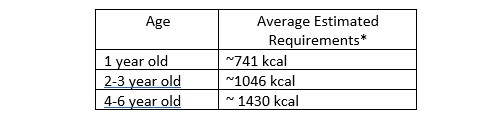
*Average calculated from SACNrequirements
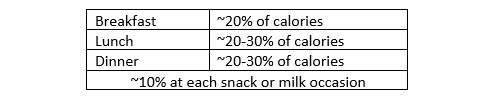
In terms of calorie requirements and meals/snacks throughout the day, you can think about snacks as mini meals and food intakes spread throughout the day ROUGHLY as laid out below. Please be aware, this is JUST a guide and it’ll vary so much from child to child. I’d never encourage parents to count their children’s calories. Kids are VERY good at regulating their own appetites as long as they are offered a nice routine/structure around mealtimes and plenty of variety and balance. However, it’s a good idea to keep these in mind when opting for pre-packed meals and snacks for your toddlers.
Traffic Light System
Something most of us will have seen is the “Traffic Light” system which is used on the front of a pack to show whether a product is high in energy, fat, sugar and salt. It can be a useful way to quickly determine what’s in a product, but it can also be a bit misleading if the portion size isn’t properly labelled, is only relevant for adults and it can also misrepresent the nutrition of certain products. For example, the labelling on nuts is often red for energy and total fat, when most of the fats found in nuts are unsaturated fats, and the high fibre content means that not all of the energy is absorbed when they’re eaten. Equally, yoghurts and cheese often show red for saturated fat content, but these foods are great sources of other nutrients for kids including protein, calcium and iodine.
The graphic below shows the different amounts that determine whether a product has a low, medium or high content of a certain nutrient and the colour you’ll see on the front of the packet.

Adapted from: https://www.food.gov.uk/sites/default/files/media/document/fop-guidance_0.pdf
Nutrition & Health claims
These are the statements on food packaging that say ‘high in…’ or ‘source of…’ There are guidelines around this to specify how much a product should contain of a certain nutrient to allow these claims to be made. Most of the time, these are simply marketing terms and you don’t need to use them to choose a certain product. If your little one has an overall healthy, balanced diet from a variety of foods and snacks, checking the nutrition and the ingredients are all you really need to pay attention to on labels.
Sugar: ‘Natural’ vs Added
Sugar can be especially confusing when it comes to reading labels as under the current guidelines, both “free sugars” and those that are naturally occurring, such as in milk and whole fruits, will be included as sugar on the label. To find the amount of sugar on a label, you can check “of which sugars” which comes under carbohydrates, like this:

While many products may have the label “no added sugar,” it doesn’t always mean they’re lower in sugar or automatically a healthier choice. A good example is to compare a plain and a flavoured yoghurt option:
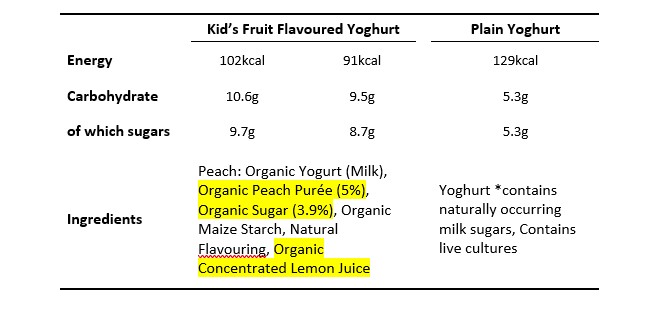
You can see that the flavoured variety of the yoghurt is higher in sugar and that the additional sugar has come from added sugar. While it doesn’t mean you need to completely avoid those products, another option might be to go for the plain yoghurt and add your own fruit to get in more of the vitamins and minerals from the fruits themselves. It’s also a really good example of how you don’t need to buy separate products for your little ones – you can buy the same product for the whole family.
You can read more about sugar recommendations for young children, here.
Organic
Many products on the market today use labels like “natural”, “organic” or “no preservatives” as a way to promote the healthfulness of the product. In the report produced by the government, research suggested that these kinds of labels indicated to consumers that they were healthier options and therefore didn’t need to check the label!
While the Food Standards Agency has rules around what foods can be labelled as ‘organic’ or not, it is a common misconception that organic foods, or foods that are ‘natural’, are automatically healthier.
I’ve written before about organic food for baby and the planet, but with regards to reading food labels, it’s still important to check the label and the ingredients, regardless of whether the packaging suggests that something is healthy. Often times the organic version is much more expensive any may still be high in sugar or salt.
Summary and take-home tips
While food labels and health claims are regulated, commercial standards do not always match up to guidelines and so knowing what to look out for can be a useful way to navigate them! To summarise everything that I’ve covered in both this blog and the previous one, here are my top tips when it comes to reading food labels for toddlers:
- Read the ingredients list: this will be on the back of the packet. The first ingredients in the list make up the highest proportion of the total ingredients
- Check the portion sizes: if the food isn’t aimed specifically for children, remember to adjust this – roughly half the adult portion
- Read the sugar content and source: the amount on the label will include both natural and added sugars – fruit juice concentrate, puree and dried fruits are considered “free sugars” so limit these where possible
- Check for added salt: The total daily intake for up to 12mths is recommended to be <1g and for 1-3yrs, <2g
- Allergies are listed in bold: most products will also include notes on the processing of the product for potential contamination
- Organic food is not automatically healthier, and may be more expensive, still check the ingredients to check if the ingredients match up to the label.